
Adult & Pediatric Orofacial Myofunctional Therapy in Brown Deer, WI
If you or your child are struggling with chronic mouth breathing, sleep apnea, or dental relapse, the root cause might be an Orofacial Myofunctional Disorder (OMD). Located just minutes from Brown Deer, Mequon Speech & Learning Connection provides specialized, medical-based muscle therapy to physically retrain the neuromuscular system and restore proper function to your airway, jaw, and tongue.

Beyond "Bad Habits": The Neuromuscular Root Cause of OMD
Many people think of oral myofunctional disorders, or OMDs, as “bad habits.” They may describe themselves as a mouth breather or say they have a lazy swallow. But these patterns are not character flaws, and they are not simply a matter of willpower.
In myofunctional therapy, we understand them differently. These signs often point to an unhealthy neuromuscular pattern that the body has learned over time.
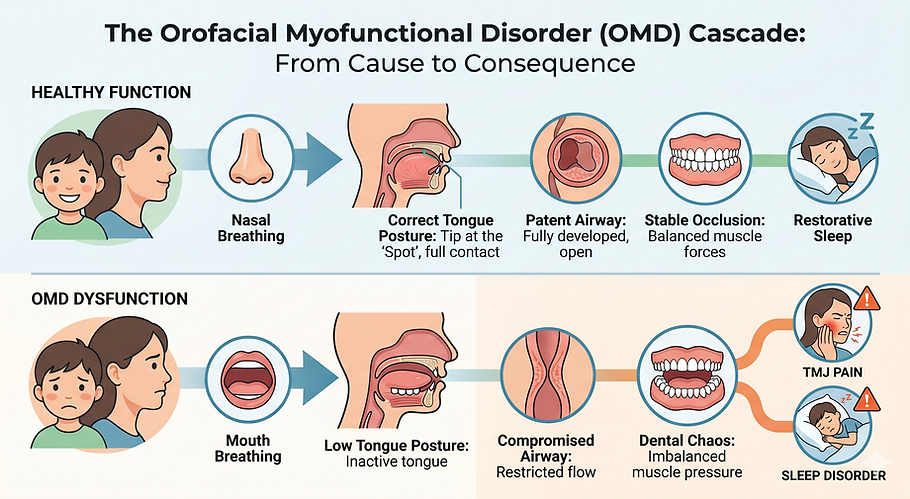
An OMD happens when the muscles of the face, mouth, and throat are no longer working the way they were designed to. This is less about choice and more about muscle memory. When the tongue is not resting on the palate, where it naturally belongs, it often drops lower in the mouth and closer to the airway. The body then begins to adapt to that position.
Over time, that adaptation can create a chain of problems. This is the “chronic dysfunction loop.”
The tongue’s resting posture matters more than most people realize. If the tongue rests low instead of up against the palate, it can contribute to a narrower airway. That may make it harder to breathe well, especially during sleep, when the body should be able to rest and recover.
Swallowing patterns also play a major role. Most people swallow between 500 and 2,000 times each day, and each swallow can place about 1.5 to 3 pounds of pressure in the mouth. When that pressure is directed correctly, the system works as it should. But when the tongue pushes forward or presses in the wrong place, that repeated force can gradually move teeth out of alignment.
Pediatric Myofunctional Therapy (Ages Birth–18)
As children grow, the muscles of the face, mouth, and airway help shape how the palate and jaw develop. Pediatric myofunctional therapy supports healthy oral posture and breathing patterns during these important years, when small changes can make a big difference over time.
When an oral myofunctional disorder (OMD) goes untreated, it can affect more than habits. It may contribute to narrow dental arches, crowded teeth, and speech sound errors such as lisps. Because a child’s muscles and bones are still developing, early support can help guide healthier function and development.
How early therapy can help
-
Encourage proper tongue posture and oral rest posture
-
Support healthy palate and jaw growth
-
Reduce the risk of severe dental crowding
-
Improve muscle patterns that affect speech clarity
-
Help limit the progression of issues that may lead to more complex orthodontic needs later
Early intervention is not about blame. It is about recognizing developing patterns and helping your child build healthier ones while growth is still on their side. With the right support, we can retrain these muscles early and often reduce the severity of future orthodontic treatment.

Adult Myofunctional Therapy
Many adults have lived with the effects of an oral myofunctional disorder (OMD) for years without realizing it. What seems like an unrelated issue may actually be part of a larger pattern involving the muscles of the mouth, face, and airway.
These long-standing patterns can show up in ways that affect daily comfort and quality of life, including:
-
Ongoing TMJ or jaw pain
-
Chronic tension headaches
-
Trouble tolerating CPAP
-
Teeth shifting after braces or orthodontic treatment
Adult myofunctional therapy focuses on retraining these patterns through neuroplasticity, which is the brain and body’s ability to learn new muscle habits over time. Even if these patterns have been in place for decades, they can often be improved with the right support and guided therapy.
By helping the muscles work in a healthier, more coordinated way, treatment may support pain relief, better airway function, and a more stable bite. The goal is not just to manage symptoms, but to address the underlying pattern that may be contributing to them.
A Unified Clinic for Brown Deer Families
Located just a short drive from Brown Deer, Mequon Speech & Learning Connection offers a comprehensive, collaborative clinic model. We are unique because we bridge the gap between your dentist, orthodontist, ENT, and pediatrician.
We do not just treat the "habit." We treat the structure. We know that a tongue tie must be diagnosed and potentially released (frenectomy) before the muscles can be properly trained. We look at the total system—airway, sleep, structure, and muscle function—to create lasting, medical-based results that generic exercises cannot achieve.
Partner with us to achieve a life of better breathing, safer swallowing, and stable dental health.
Conveniently Located
At Mequon Speech & Learning Connection, we offer medical-based care just minutes from Brown Deer, making it easier for families and adults to stay consistent with treatment. Our clinic is close by, so you can access specialized support without a long or difficult commute.
We welcome patients from Brown Deer and nearby communities, including:
-
Mequon: Just north of Brown Deer and an easy drive to our clinic
-
River Hills: A close neighboring community with convenient access nearby
-
Glendale: A short trip north for families and adults seeking specialized care
-
Bradley Estates: One of the closest nearby neighborhoods for convenient weekly visits
-
Northridge Lakes: Just minutes away for speech, feeding, and airway-focused support
Whether you are looking for infant suck retraining, toddler feeding therapy, or adult TMJ relief, expert care is close to home. Explore our services and find the support that fits your family.
Schedule Your Functional Evaluation
Email: office@mequonspeech.com